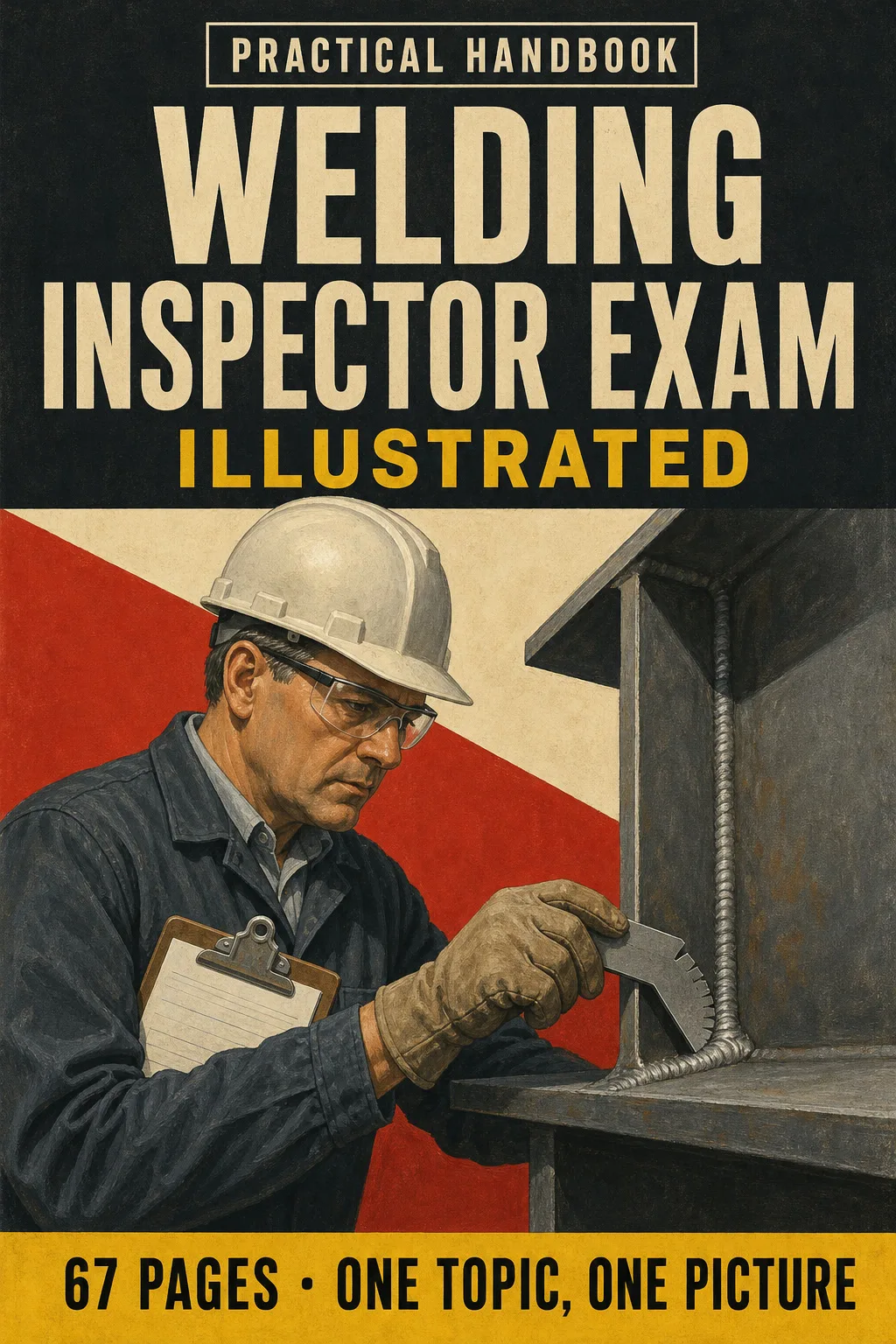
📄 Digital book in PDF · read it on your phone or print it
Weld and NDE symbols, the five joint types, discontinuities in cross-section, gauge readings, E7018, polarity, WPS and PQR, the D1.1 clause map. Each topic has its own page: first the drawing, then what you need to remember. 67 illustrated pages.
🔒 Secure checkout · PDF by email · 30-day guarantee
Every page has one large drawing and a box with the numbers and rules you need to know:


Swipe to see more →
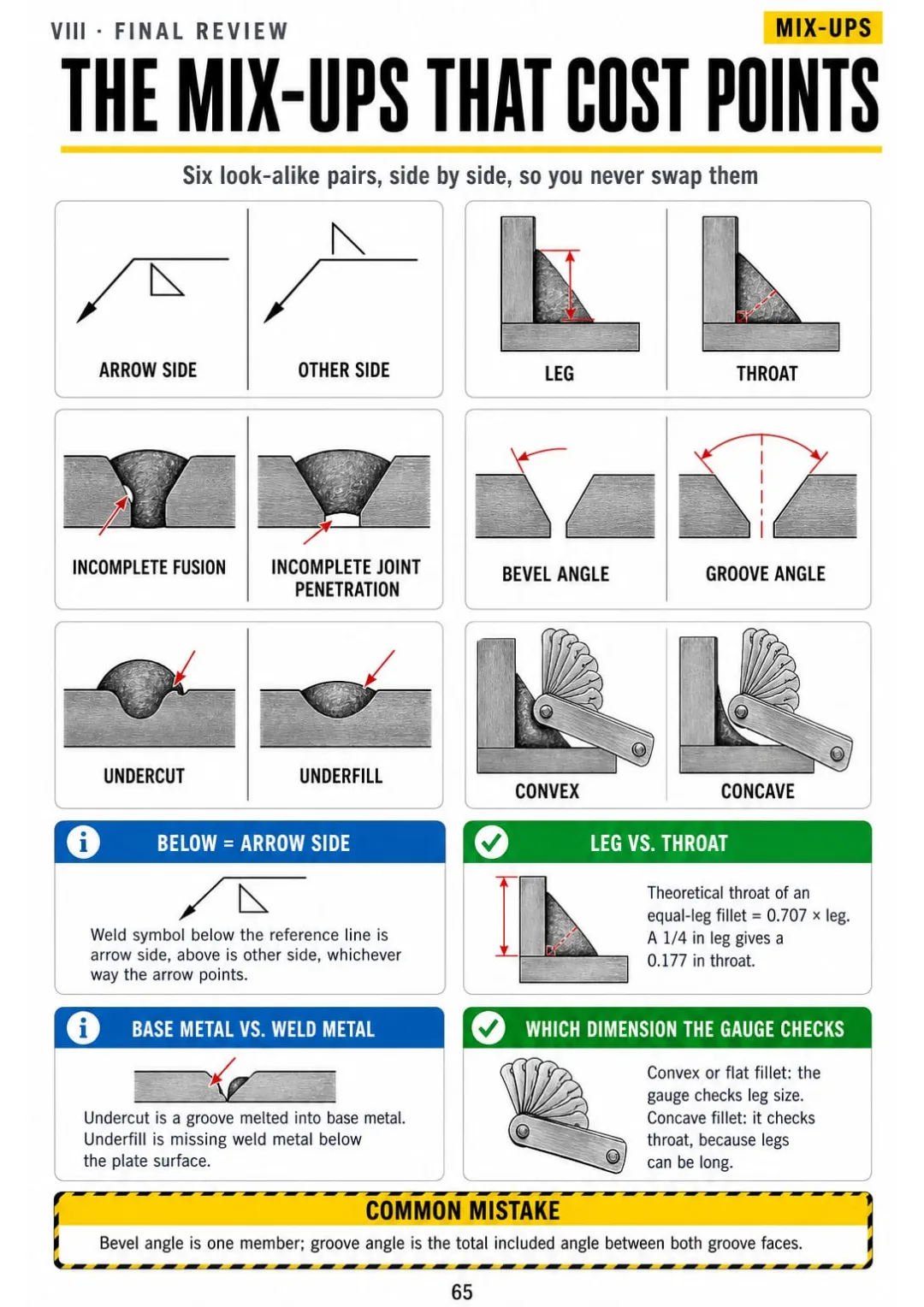
These are real pages from the book. The table of contents is the full one: 8 parts and 63 topics.
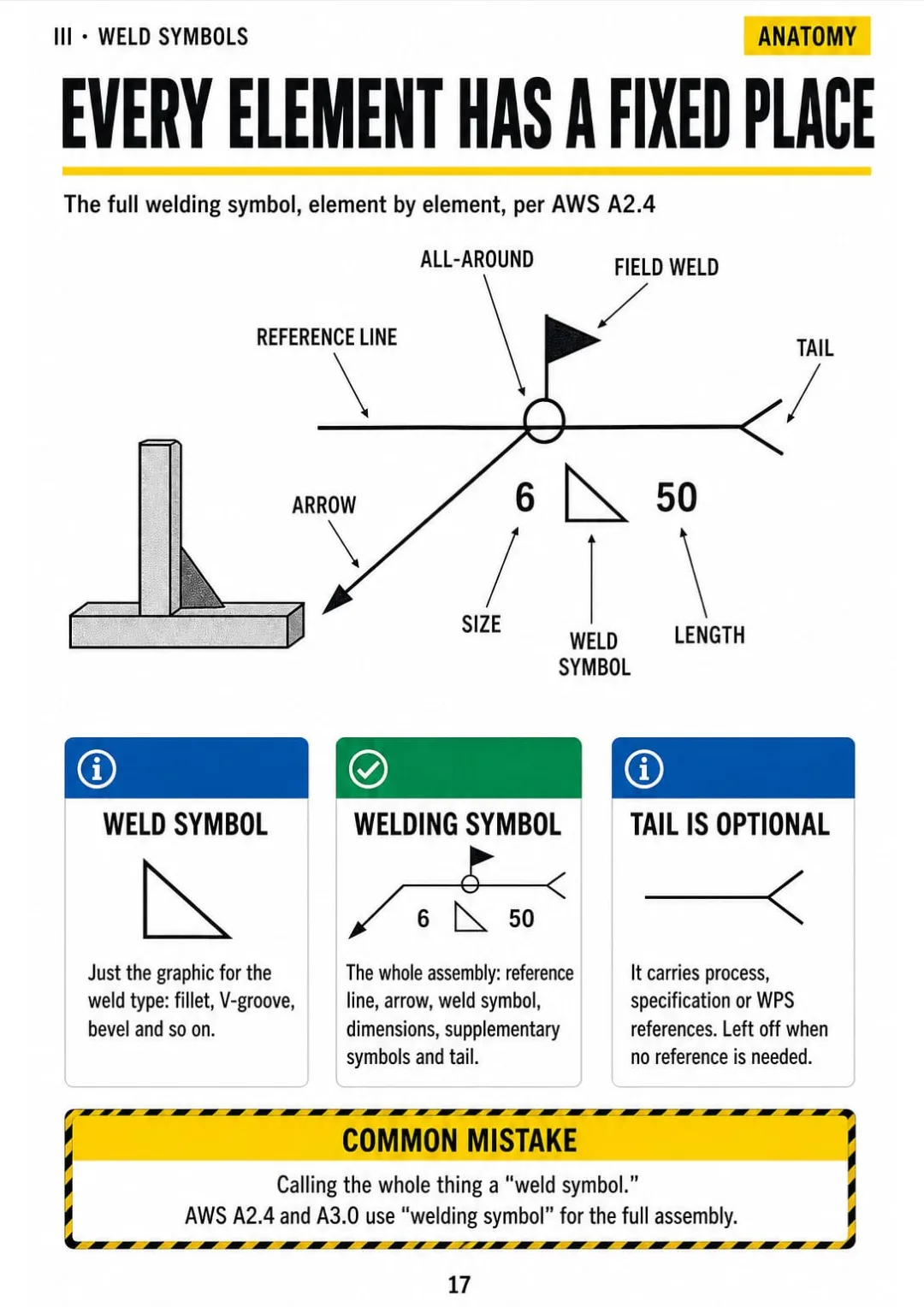
You're looking at a weld symbol on a print. There's a reference line, an arrow, a fillet triangle, a number on each side, a flag and a tail with letters in it. You've welded that joint a hundred times. On the exam, with the clock running, arrow side and other side can still flip on you.
The fundamentals book explains the symbol in paragraphs: where the dimensions go, what sits above the line, what belongs in the tail. Six elements described in words, and not one of them drawn where it belongs.

In this book, that symbol is one page. One drawing, with every element labeled in its fixed place: reference line, arrow, weld symbol, dimensions, supplementary symbols and tail. You see where each piece sits before you read a word about it.
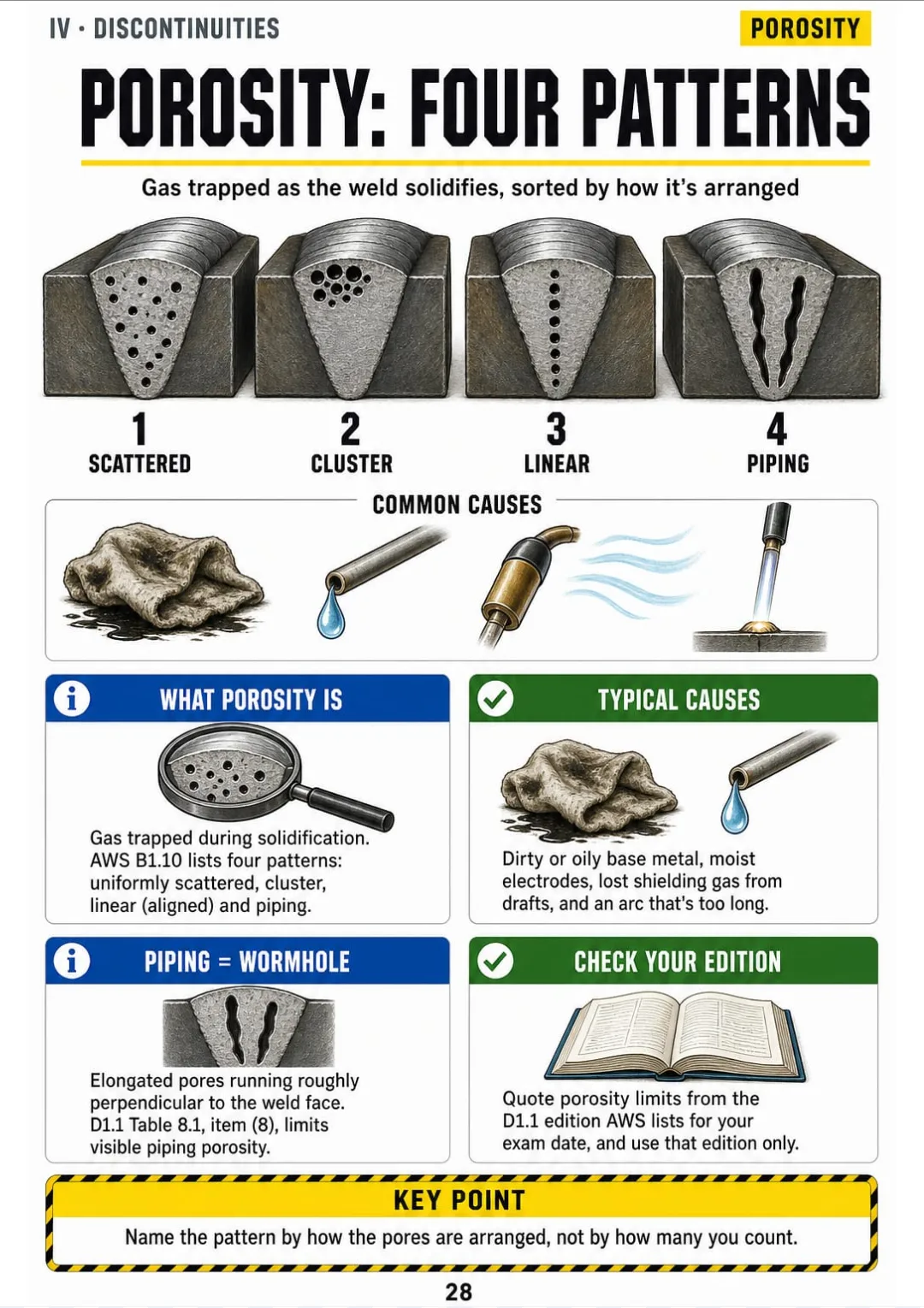
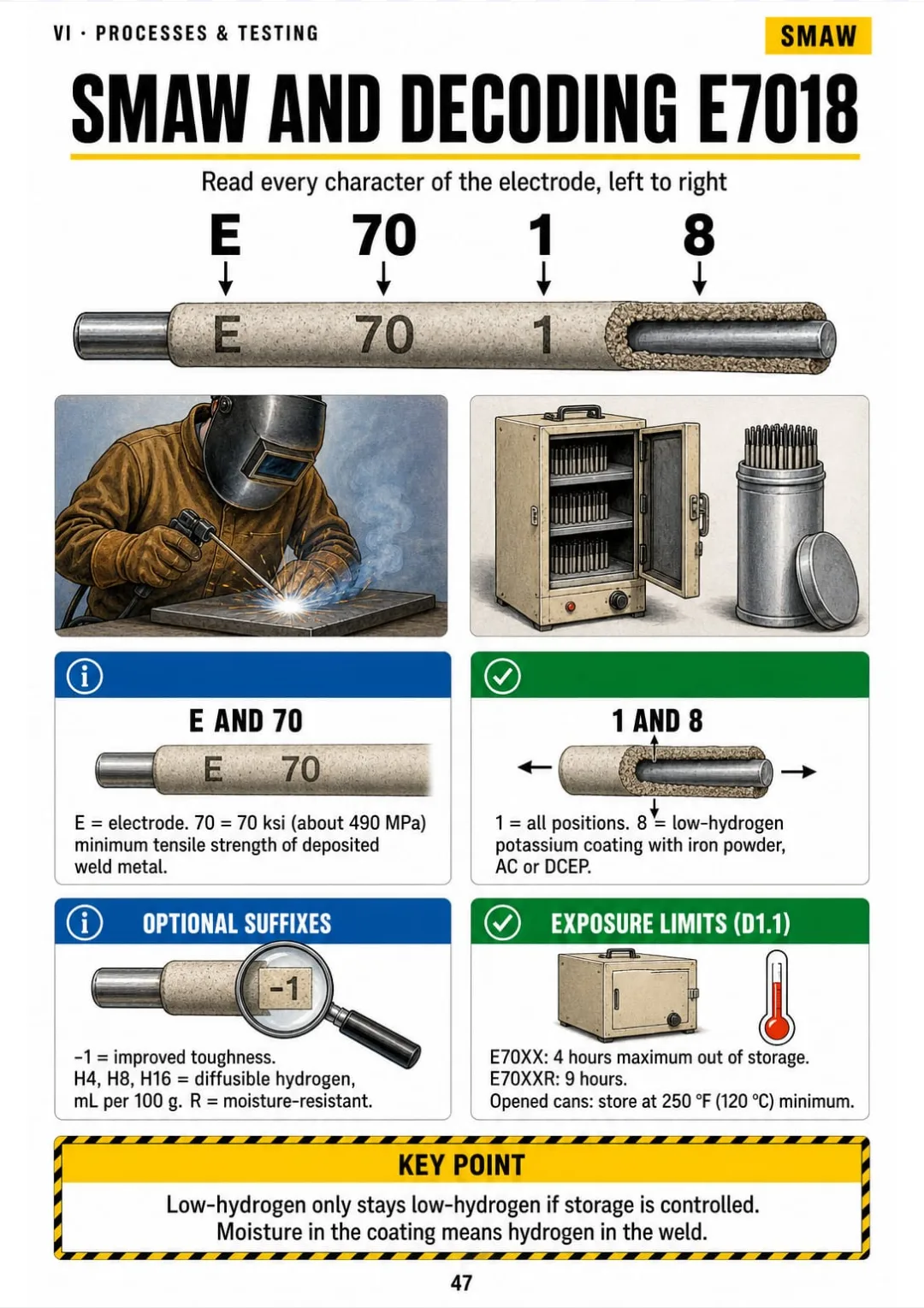
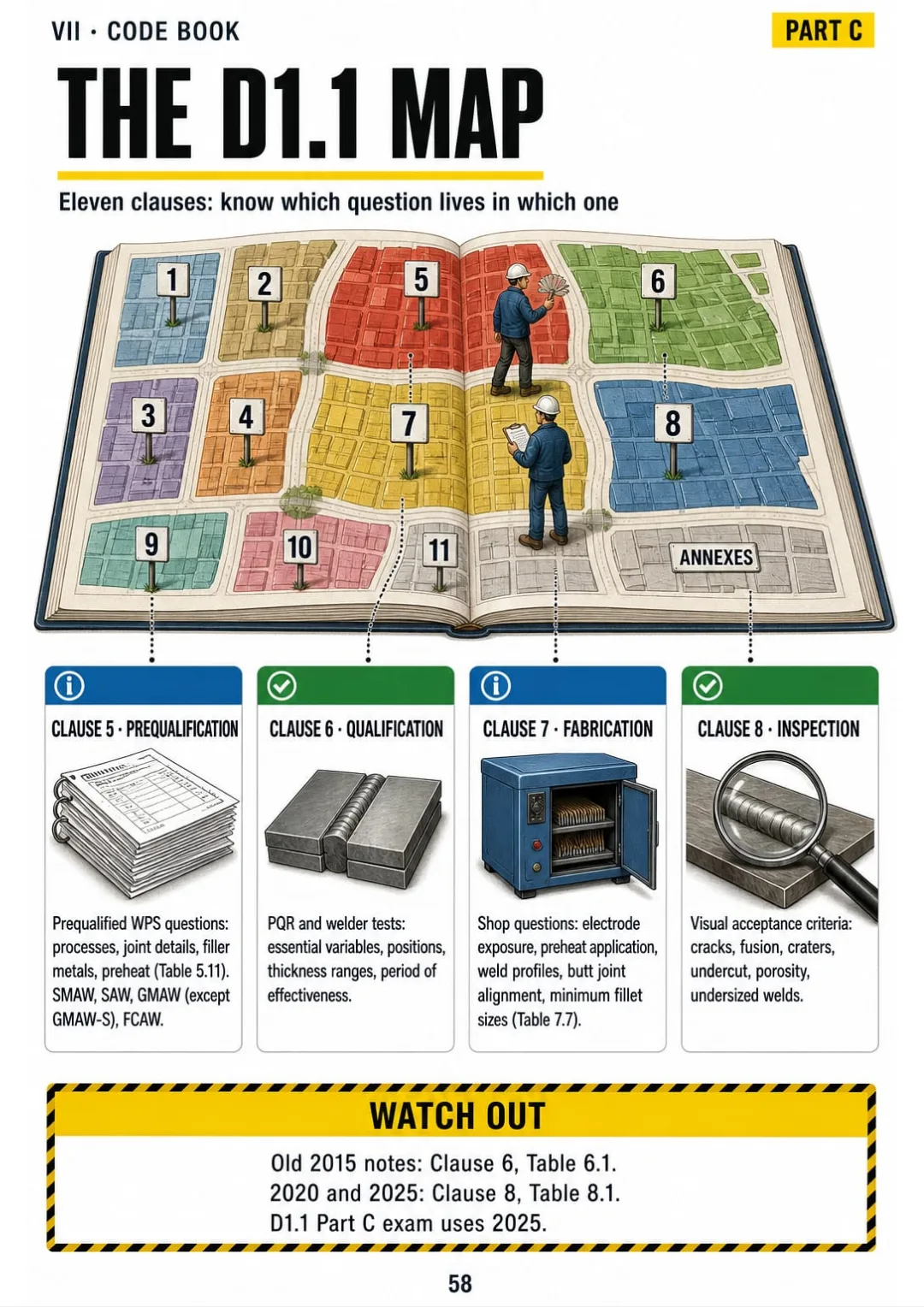
The rest of the book works the same way. Arrow side vs. other side, porosity in four patterns, the fillet gauge on a concave weld, E7018 decoded, the D1.1 clause map: each one gets its own page.
So when a symbol shows up on Part A or on a shop print, you read it element by element, in the same order, without going back to the book.
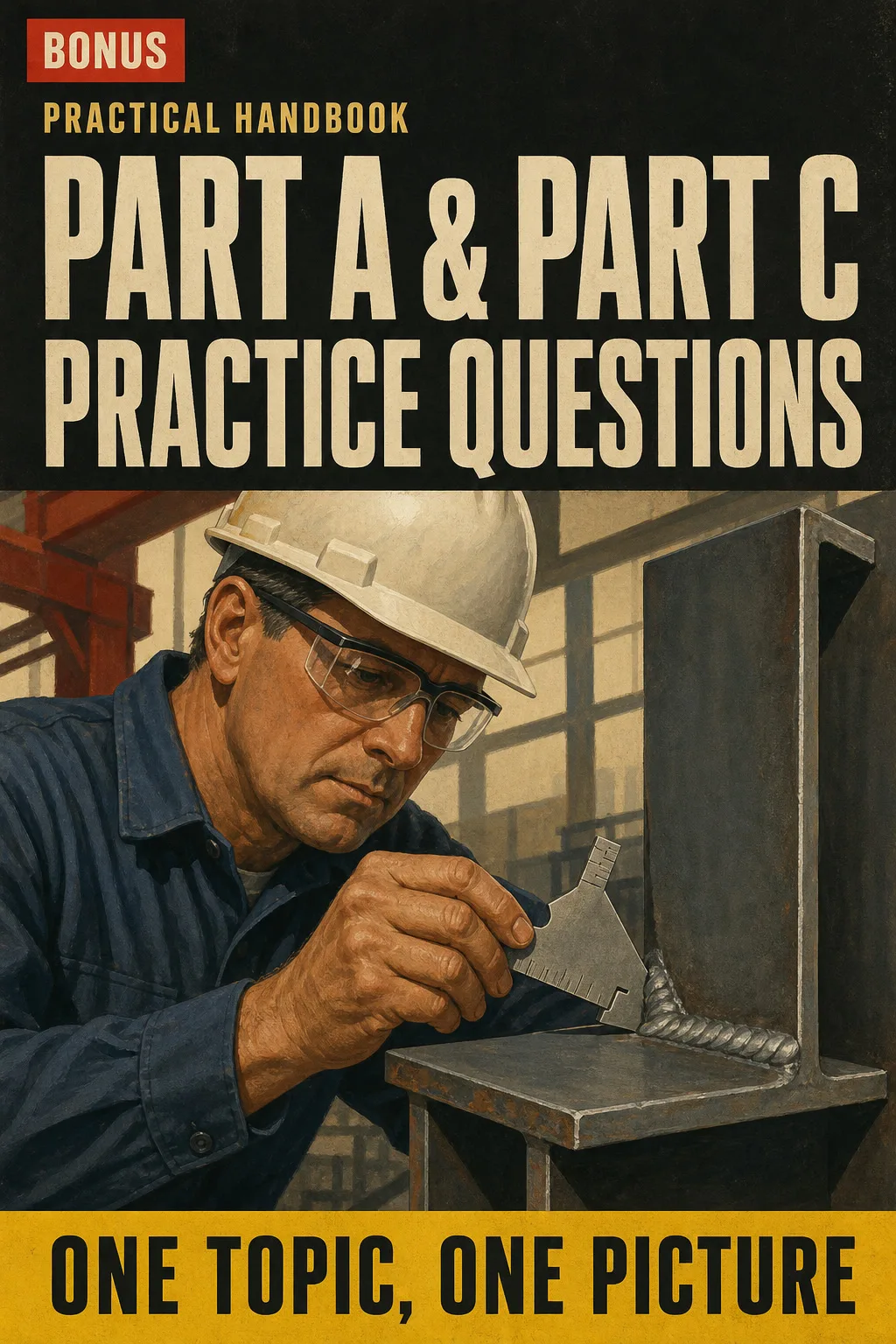
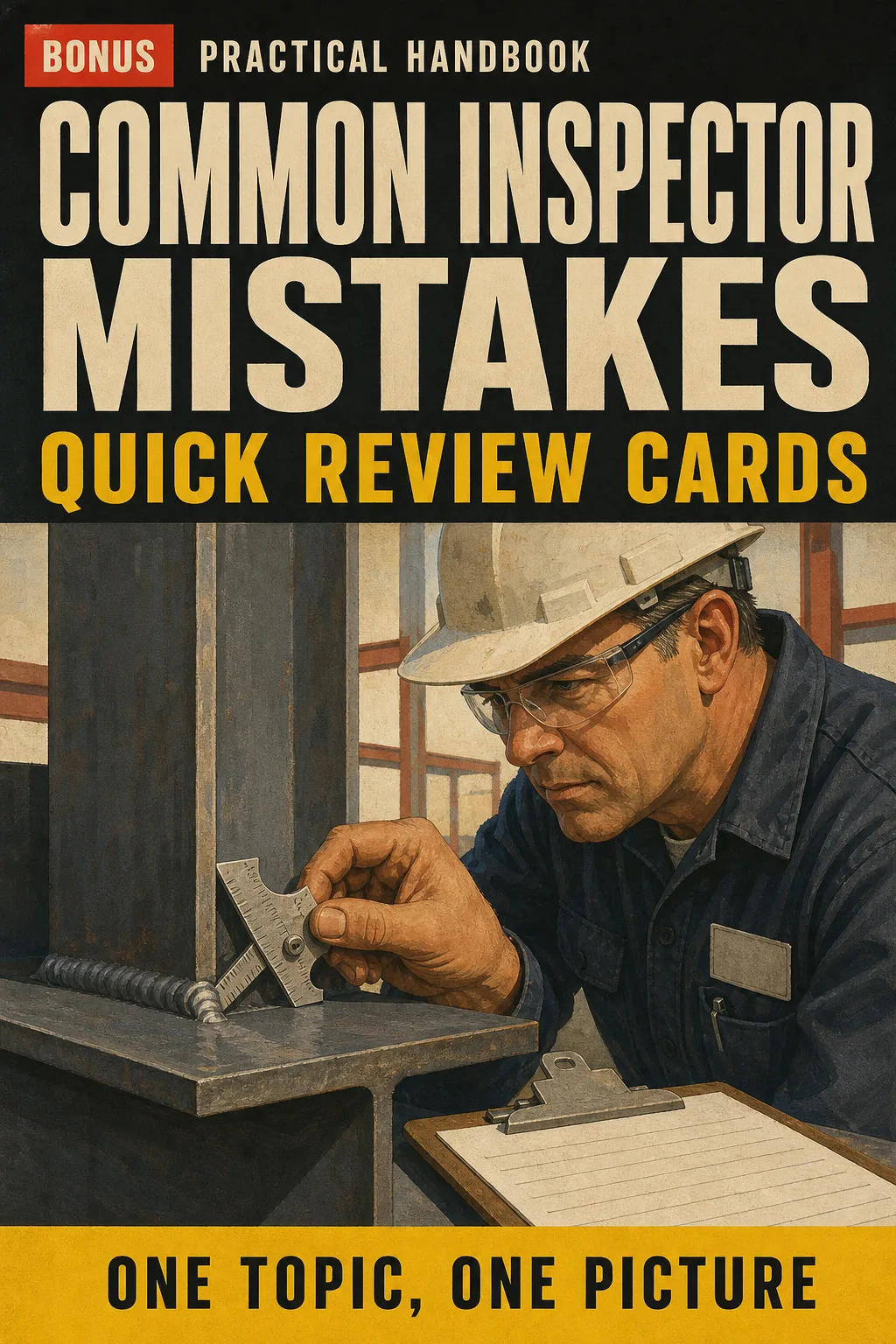
The exam and the inspector's job, joints and weld anatomy, weld and NDE symbols, discontinuities, gauges for Part B, processes and testing, the code book and qualification, and a final review: 67 pages, all illustrated.
Think of it this way:
Part B is underway. There's a fillet weld sample on the table, the gauge is in your hand, and the bead is concave.
In the book, the fillet gauge page shows both cases drawn: how the tool sits on a convex weld and how it sits on a concave one. On a concave fillet, you gauge the throat.

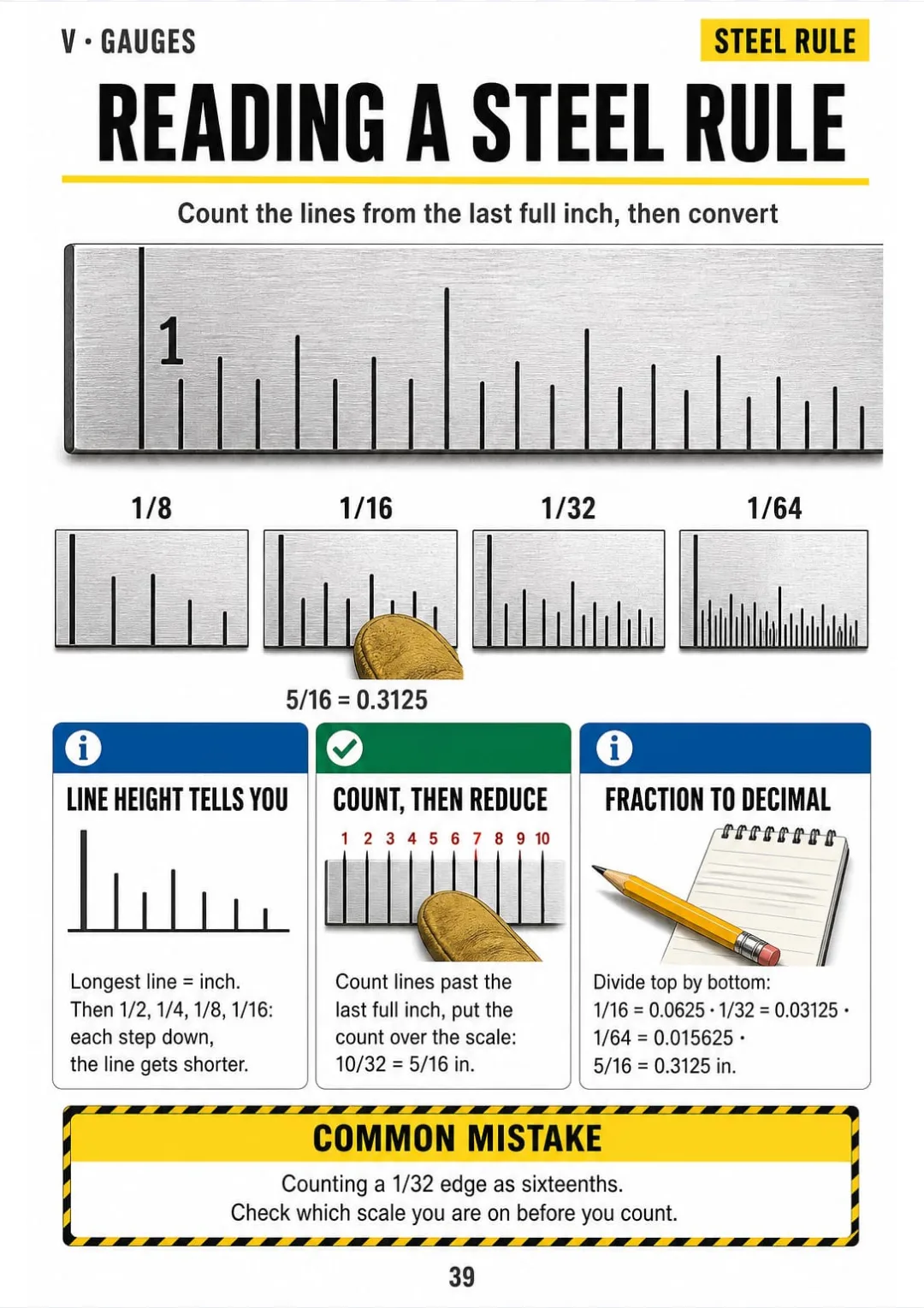
The same goes for the V-WAC, the bridge cam, the Hi-Lo, the dial caliper and the steel rule: each one on its own page, drawn the way you hold it.
Welding Inspector Exam Illustrated is 67 illustrated pages in 8 parts, one topic per page, and it ends with a final review: the mix-ups that cost points, a one-page symbol routine and an exam-week checklist.
What you see drawn, you don't have to memorize.
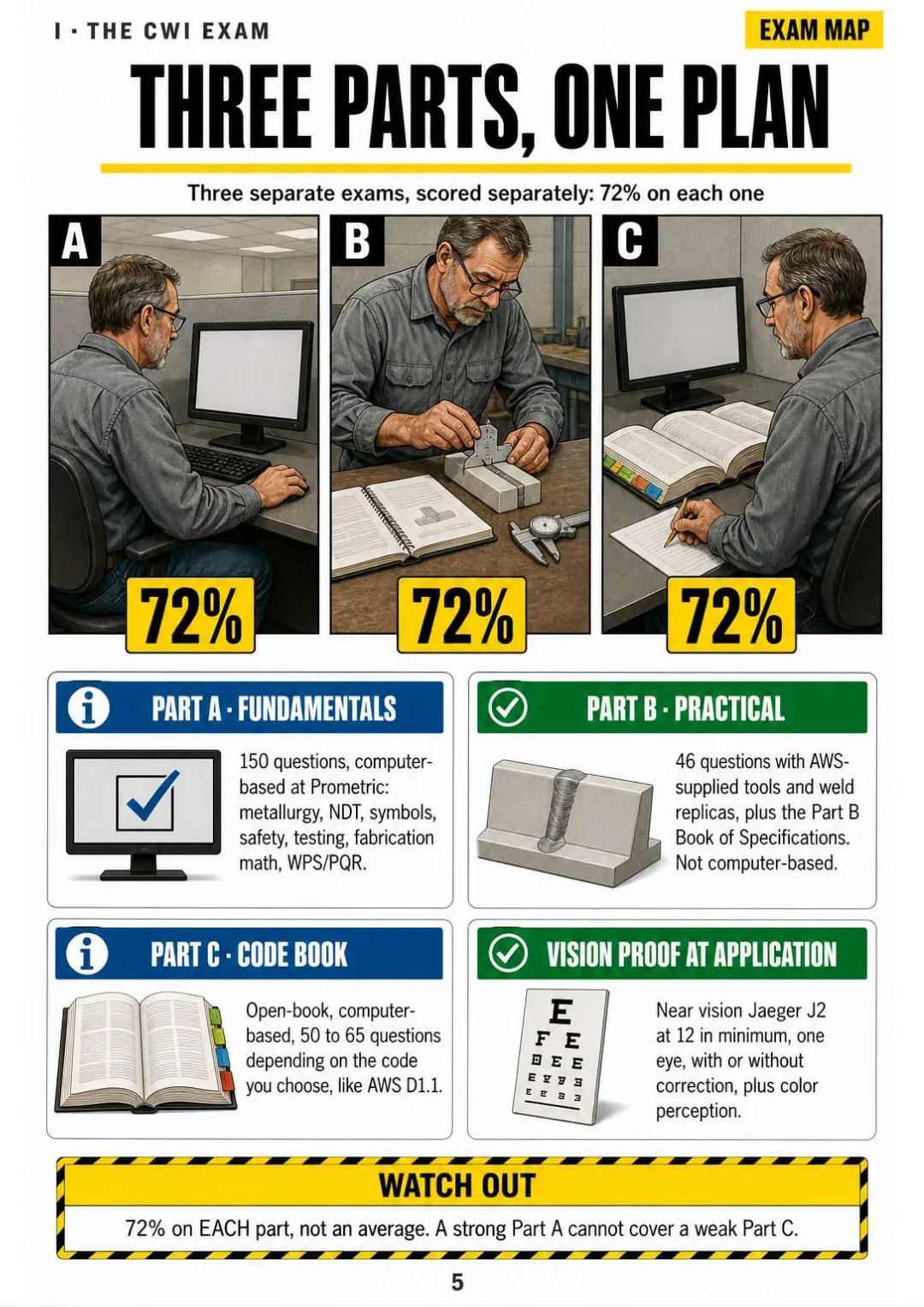
How the three exam parts work, the inspector's job before, during and after welding, code vs. specification vs. standard, discontinuity vs. defect, and safety on the inspection floor.
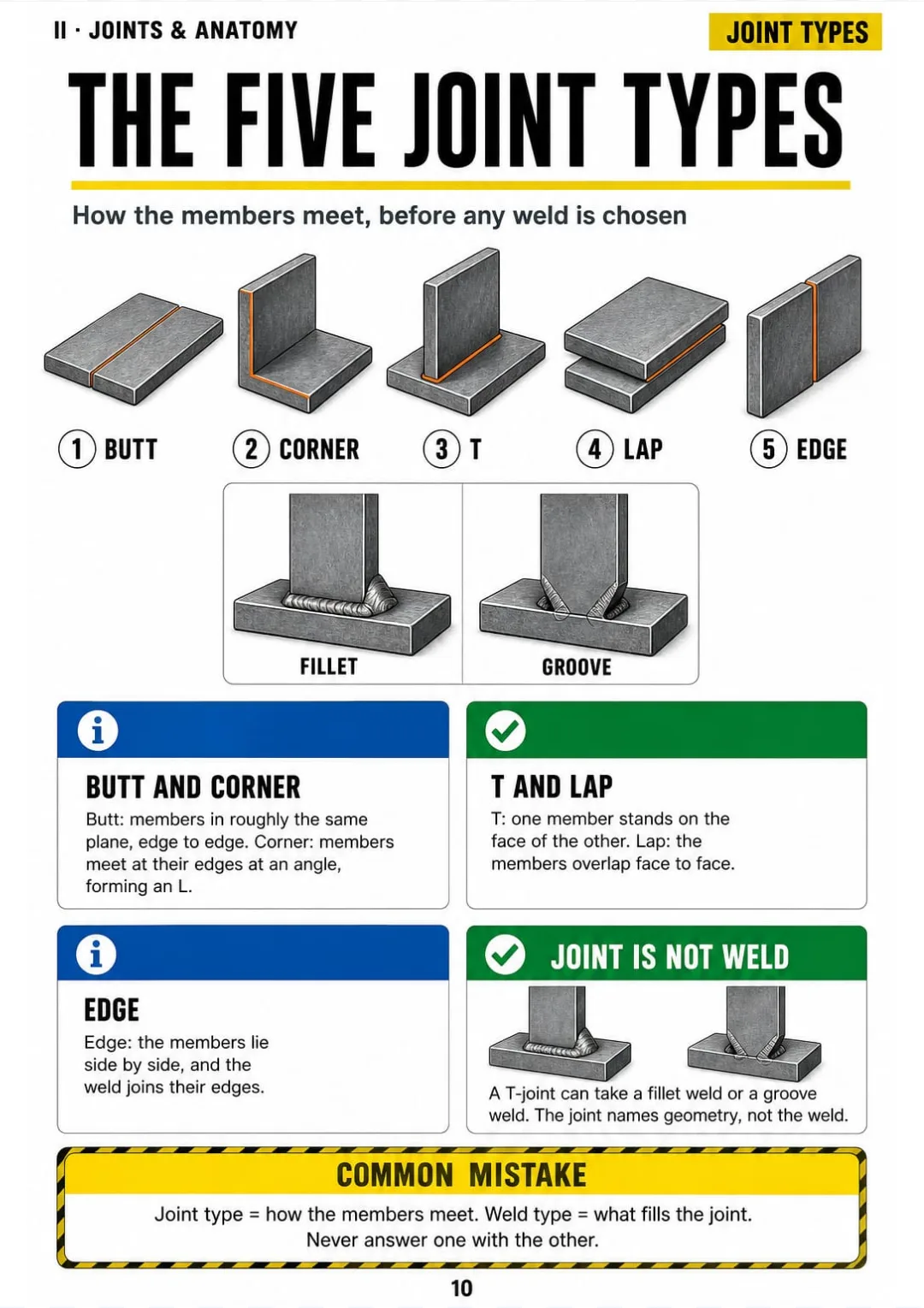
The five joint types, groove weld types and joint anatomy, plate and pipe positions, and the parts of a fillet weld and a groove weld.
Every element of the weld symbol in its fixed place, arrow side vs. other side, fillet and groove dimensions, the broken arrow, supplementary, contour and finish symbols, and NDE symbols.
Porosity, inclusions, incomplete fusion and joint penetration, undercut, underfill, overlap, cracks, lamellar tearing and profile problems, each one in cross-section.
Steel rule, dial caliper, fillet gauge, V-WAC, bridge cam and Hi-Lo readings, visual examination conditions and a Part B workflow.
SMAW and E7018, GMAW, FCAW, GTAW, SAW and thermal cutting, polarity, heat input, preheat and interpass, mechanical tests and the main NDE methods.
The D1.1 map, finding a table fast, prequalified joints, WPS, PQR and WPQ, essential variables, what a welder test qualifies and the visual acceptance table.
The mix-ups that cost points, a one-page symbol routine and an exam-week checklist.
At the end of the book: A final review with the most common mix-ups, a one-page symbol routine and an exam-week checklist.

Exam-style questions on fundamentals and code book navigation, each with the answer explained, so you test yourself before exam day and see why each answer is right.

The mix-ups that trip people up most often (arrow side vs. other side, leg vs. throat, incomplete fusion vs. incomplete penetration) on one-page cards you can review in minutes.
📄 This is a digital PDF book sent to your email: nothing is printed or shipped.
PDF by email: We email you Welding Inspector Exam Illustrated as a PDF, together with the two free books. It's a single payment: no installments, no extra charges.
Years of welding already taught you the joint. The book adds what the inspector exam asks: symbols, discontinuities, gauges and the code book, one page each.
Review a full part in one sitting and go back to the exact page you need: the gauge you're unsure of, the symbol that keeps flipping, the D1.1 clause map.
If you've never struck an arc, every discontinuity is drawn in cross-section next to its common causes, so you see what you're inspecting.
📄 This is a digital PDF book sent to your email: nothing is printed or shipped.
Try Welding Inspector Exam Illustrated for 30 days, bonus books included.
We refund everything if the file won't open, if the book isn't what you see here, if you were charged twice or if the email doesn't arrive. Just email us.
You pay once. No subscriptions.
Yes. It isn't a welding course: it covers what the inspector exam asks, from symbols and discontinuities to gauges and the code book. It also works if you come from QA/QC and have never welded.
From AWS QC1 and the AWS publications in the CWI Body of Knowledge: A2.4, A3.0, B1.10, B1.11 and D1.1/D1.1M. Every page is checked against them. The D1.1 map uses the current clause numbering: Clause 5 prequalification, 6 qualification, 7 fabrication, 8 inspection. If your code book shows the same numbers, the map matches it. The book doesn't reproduce the code text, so for Part C you still need your own code book, in the edition your exam uses.
No. It's independent study material, not affiliated with or endorsed by the American Welding Society. It doesn't give you a certificate or credit hours: the CWI certification comes only from AWS, after you pass the exam.
No. It's for studying and reviewing alongside your seminar, your course or the official publications. For Part B it shows how each gauge sits and how to read it, drawn the way you hold it. You still practice with real gauges and weld samples.
No. They're written for this book, in the style of Part A and Part C, and each one comes with the answer explained.
The book and the 2 bonus books arrive as PDFs by email, at the address you enter at checkout.
No. It's a one-time payment.
Yes. It's a PDF you can print at home or at a print shop and keep at the shop.
You have 30 days. We refund everything if the file won't open, if the book isn't what you see on this page, if you were charged twice or if the email doesn't arrive: just email us.
No more rereading chapters that don't stick.
Every element of a weld symbol, you see it drawn in its place.
You walk into the exam knowing where everything is.
Drawings make studying faster.
The book is right below.
One-time payment: US$ 27 · Guarantee: 30 days · PDF by email
YES, I WANT WELDING INSPECTOR EXAM ILLUSTRATED FOR US$ 27📄 This is a digital PDF book sent to your email: nothing is printed or shipped.